European Gentrification Series II Part 1
This new series of articles expands upon the work we have done in understanding the dynamics of the city with more attention to methodology than we have ventured into in the past. Whereas the ‘why’ questions related to urban development have now been somewhat answered, the ‘how,’ through the lens of the hyperlocal 100-meter grid, offers the possibility of understanding the question of gentrification on a scale greater than the individual city, bucking the trend of studying individual neighborhood phenomena to understanding the entire metropolitan structure. Geographically, the neighborhood units studied are now for entire European regions, shifting the scope of individual city observations to the entire metropolitan structure.
A Data Scientist’s View on Gentrification
Gentrification has long been viewed through the lenses of economists, sociologists, and geographers. Their work remains foundational and has helped to frame the conceptual backbone through which we understand neighbourhood change, displacement, and reinvestment. But for all its academic richness, the field is missing what industry professionals desperately seek: a systematic, data-driven approach that uncovers what’s actually happening in cities at the level and frequency at which investment decisions are made. This is where our data scientists’ perspective adds value.
Our empirical language to quantify gentrification
In our research, we approach gentrification with a different methodology, one rooted in data science and long-horizon spatial modelling. The goal is not to redefine theory but to operationalise it and to transform conceptual insights into measurable indicators that evolve. By integrating regional statistics with hyperlocal 250- and 100-meter grids, we construct an empirical language for understanding neighbourhood transformation grounded in actual behavioural patterns of residents, businesses, and amenities.
Early detection through our data science approach
Gentrification does not have a fixed definition; it is an identifiable series of spatial and temporal signals based on many different factors. A rise in property values alone constitutes no gentrification. Demographic change alone is no gentrification. Rather, amenity growth and shifting socioeconomic profiles interact as improvements in accessibility and precede the eventual visibility of gentrification on the street. The advantage of a data science approach is that these patterns become detectable long before they are recognisable in physical form.
Navigating the duality of opportunity and risk
For investors and developers, gentrification can offer opportunity and add risk. Starting on the one side, neighbourhood upgrading corresponds with improved housing stock, enhanced safety perception, and the arrival of new services that strengthen long-term value. On the other side, displacement pressures, regulatory tightening, and community pushback create volatility. Our objective is not to take a normative stance but to create an analytical environment where both sides can be evaluated with precision.
Measuring the drivers of momentum
This shift from theory to data lets us discover relationships, hinted at in the literature but not measured in the way that matters most. Amenities are one example of early behavioural signals. Their growth frequently predates demographic change by several years. Another structural factor, transit accessibility, has a lasting impact independent of recent infrastructure investment. Property value slopes, not absolute prices, emerge as one of the most powerful forward-looking indicators, showing momentum, not static status.
From description to predictive modeling
What emerges from these observations is a more nuanced model of urban transformation, one that understands gentrification as an interconnected system of economic, cultural, social, spatial, and infrastructural dynamics. By quantifying those domains, we go from description to prediction. And along the way, we create a foundation for a series of larger considerations about how these insights can be operationalised for the real estate sector.
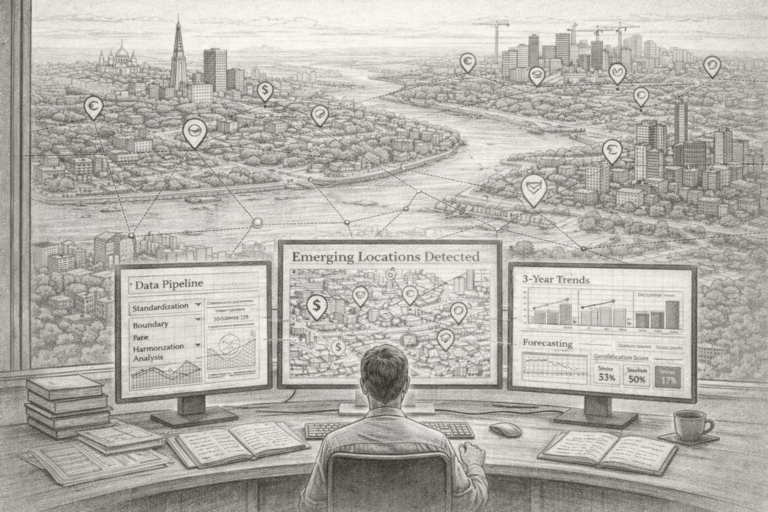
Looking ahead: The data pipeline
This our second gentrification series.
In our four-piece series exploring how data science reshapes our understanding of urban dynamics. In the next article, we are going to dive into the construction of the full data pipeline and its architecture, which will enable consistent location analysis for investment purposes.
Our first series about Gentrification can be found here:
https://krafin.tech/hyperlocal-european-gentrification/
https://krafin.tech/from-streetview-to-street-value/
https://krafin.tech/how-behavioral-dynamics-drive-property-markets/