European Gentrification Series II, Part 3
Tourism as a catalyst for urban change
While classic gentrification theory revolves
around residential mobility, reinvestment dynamics, and economic restructuring,
there is a particular pattern that has taken place over the last decade
throughout European cities: tourism-induced urban transformation. The changes
in the neighbourhoods in Amsterdam, Barcelona, Lisbon, Prague, or Copenhagen
all show striking similarities to the indicators of gentrification; still,
their engine is not the internal demographic shift but rather the visitor
inflows. Our analytical framework provides a window into understanding this
type of process.
Mechanisms of tourism-induced transformation
Tourism reconfigures neighbourhoods via a
series of mechanisms parallel to those observed during the early stages of
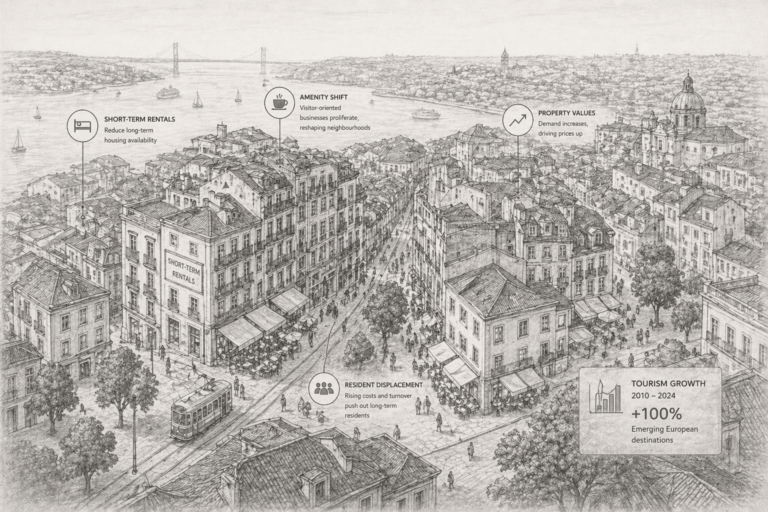
gentrification. Short-term rentals reduce the availability of long-term
housing, driving rents up and increasing turnover. Amenity ecologies
dramatically shift toward visitor consumption as cafes, boutiques, cultural
venues, and nightlife spots proliferate. Investment in infrastructure is next,
with upgraded transportation access positioning the city in global flows. Each
of these factors drives up property values and shifts neighbourhood identities
well before any change in resident composition.
Mapping the correlation between growth and
change
To demonstrate this dynamic empirically, we
looked at tourism overnight data across European city-regions, comparing 2024
volumes (where available) against a 2010 baseline at the most granular NUTS
level for which a continuous time series is available. The ranking reveals a
striking pattern: the regions that have experienced the most rapid tourism
growth also show the most significant changes in neighbourhood-level indicators
linked to gentrification in our model. Emerging destinations such as Porto, Copenhagen,
Amsterdam, Krakow, and Lisbon stand out with growth rates close to or exceeding
100% over this period, while established capitals such as Paris and Barcelona
grew far more modestly. We show below a map of the fastest-growing tourism
destinations based on Eurostat data:

Inequality and feedback cycles in the urban
core
This development of tourism is not
geographically uniform; the imbalance in tourism concentration within districts
exacerbates spatial inequality and accelerates localised transformation cycles.
For example, amenity density in our model is one of the first behavioural
indicators and tends to increase fairly rapidly in tourism-exposed areas. This
contributes to a feedback cycle, wherein both visitors and high-income
residents are attracted. The resulting pattern of neighbourhood change is one
that structurally aligns with gentrification, even in cases when the initial
driver is exogenous.
Balancing appreciation with regulatory risk
Tourism-driven gentrification in the real
estate sector is a two-edged sword: on one hand, it comes with appreciation,
strong demand, and great rental yield potential; but on the other hand, cities
respond more and more frequently with regulatory measures targeting short-term
rentals, zoning schemes, and tourist taxes, aimed at mitigating displacement
and congestion. By positioning an investment strategy, one has to understand
these dynamics in a changing regulatory and social environment.
Shortening the urban transformation timeline
The fundamental insight here is that tourism
is an accelerator; it compresses what would normally be a decade-long
trajectory of urban change into a much shorter period. The full model
incorporates neighbourhood-level dynamics from 2006 onward; the tourism
acceleration visible across this fifteen-year window, including the pandemic
dip and the rapid recovery that followed, illustrates how rapidly these
exogenous forces can reshape the trajectory. In the final part of this series,
we introduce the dashboard we developed to track these dynamics in real-time.
It is a new decision-making tool for investors, planners, and analysts.
Let us know if you require data to monitor
your portfolios’ for tourism impact.