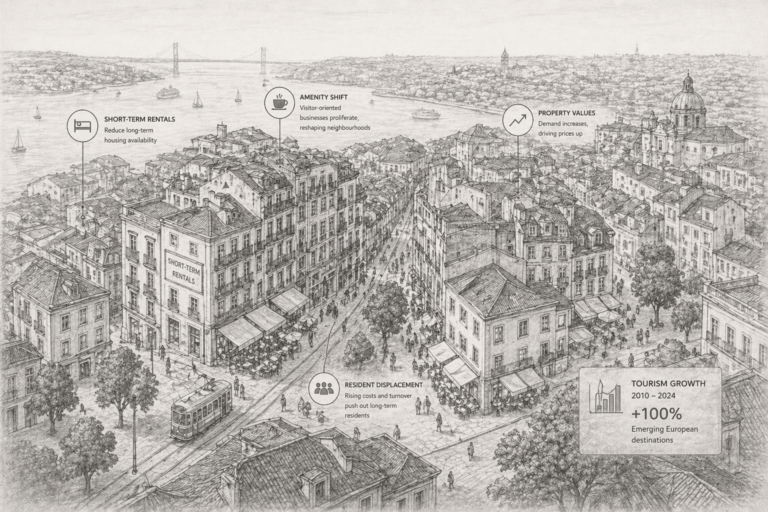
European Gentrification Series Part 4
The holy grail of real estate investment has always been a model that works across different cities and countries. Our research demonstrates that while a perfectly unified model remains elusive, we have developed a framework that using regional tweaks, can adapt to local contexts, while few caveats remain.
The Resolution Challenge
Our key insight centres on how gentrification operates at vastly different spatial scales across cities. Each city requires its own resolution to capture the details that matter and gentrification and urban development does not occur on the same scale across cities (where our previous blog shows that in cities such as Milan gentrification occurs following the leopard effect). We investigated this effect by using different resolutions for different cities: 518 neighbourhoods (346 with usable data) in Amsterdam, 33 neighbourhoods in Utrecht and 88 NIL areas in Milan, of which the latter proved too coarse to detect meaningful patterns.
From these analyses to optimal spatial resolutions, we find that neighbourhood units of around 2000-3000 residents per unit (as was the case for the Amsterdam model, more consistent results can be achieved than using bigger neighbourhoods such as the Milan NIL regions. Unfortunately, this resolution is not available for most cities.
The performance differences show that. Amsterdam’s fine-grained analysis yielded an MSE for our agent-based model, lower than the baseline and capturing genuine gentrification dynamics. We see that especially the Top 20 most gentrifying and de-gentrifying neighbourhoods are captured using the ABM model compared to the baseline models (see Table 1) On the other hand, we do see that the overall MSE score is best for the null measure, ruling that there is no gentrification as well. This shows that change is overestimated in neighbourhoods, stemming from the non-deterministic nature of the model and the relatively low number of simulation runs.

Table 1. Amsterdam Model Results
In Utrecht, on the other hand we see that the model underestimates the degree of gentrification, stemming from the fact that the neighbourhoods are too big and therefore do not capture the gentrification on lower levels (Figure 2). The top gentrified and de-gentrified neighbourhoods are not simulated well for this city, showing the limitations of the bigger neighbourhood level.

Figure 2. Utrecht comparison of real and simulated gentrification score
Milan shows almost no gentrification in the NIL regions, originating from both a bad income bucket definition from ISTAT and NIL regions being too big. These results thus show that the necessary spatial resolution for gentrification research is of around 2000-3000 people per area.
The Integrated Data Stack
Our unified framework integrates multiple data layers, each providing unique insights into neighbourhood transformation. The foundation rests on socioeconomic data tracking income distributions, housing stock, occupancy rates, and population demographics by neighbourhood. However, we’ve moved beyond traditional metrics to incorporate what we term alternative data sources.
Through automated streetview imagery analysis, we assessed neighbourhood aesthetics on a 0-10 scale, capturing visual improvements that precede measurable economic change. Greenery coverage percentages, infrastructure quality metrics, and crime indices provide additional texture to our understanding of neighbourhood character. We also integrated behavioural dynamics through sentiment analysis of news outlets and social media, capturing public perception of neighbourhood transformation as it unfolds. Movement patterns and attraction factors, weighted across multiple dimensions, round out this comprehensive picture.
One element of gentrification not yet researched is the policy and market layer, which also has a big impact on urban dynamics, such as social housing and zoning regulations. This subject will be part of future research on this topic.
The Competitive Advantage
Despite these variations, the framework offers three critical advantages for institutional investors
1. Scalability with Adaptation
Rather than forcing a one-size-fits-all model, our framework adapts to local data availability and urban morphology. The core behavioural principles remain constant while parameters adjust to local contexts.
2. Early Detection and Scenario Modelling
By integrating alternative data sources such as streetview imagery, sentiment analysis, transport data, we can capture signals before traditional indicators and simulate potential policy decisions or forecast developments such as the effect of the construction of a new metro line.
3. Risk Mitigation Through Understanding
Unlike pure statistical models, our approach includes behaviour of the population, resulting in emergent phenomena: results from interactions of individual entities that cannot be deduced to the system’s parts, but rather the interactions between the parts.
Implementation Considerations
For investors looking to leverage this framework, several factors warrant careful consideration. Data quality requirements are substantial: minimum five-year historical data for calibration, spatial resolution under 5,000 residents per unit, and multiple data sources for triangulation. The computational infrastructure demands are non-trivial, with agent-based models requiring significant processing power and scalable architecture for multi-city deployment.
Local calibration emerges as perhaps the most critical success factor. Behavioural parameters must reflect local movement patterns, income thresholds must adapt to local cost structures, and social housing alongside policy factors must be incorporated. What works in Amsterdam cannot simply be transplanted to Milan without fundamental adjustments, but can fit into the same framework, fine tuning parameters that differ in regions.
The Future of Urban Investment Analytics
Our research represents a fundamental shift in how we understand urban transformation. By combining behavioural modelling with alternative data sources, we’re moving beyond backward-looking statistical analysis to forward-looking simulation of urban dynamics. However, the research also reveals significant limitations that must be addressed, such as spatial resolution and availability of data.
The implications extend beyond individual investment decisions. This framework enables portfolio-wide risk assessment across multiple cities, scenario planning for policy changes or economic shocks, and identification of emerging patterns before market recognition.
Our framework represents just the beginning. With expanding data sources and improving computational capabilities, the ability to predict and profit from urban change will only grow more sophisticated. The question for investors isn’t whether to adopt these new methodologies, but how quickly they can integrate them into their investment process.
The winners in tomorrow’s real estate markets will be those who can decode the complex interplay of behavioural dynamics, policy interventions, and neighbourhood characteristics that drive urban transformation. Our framework represents an initial foundation for this push. It shows that we can benefit from the use of agent-based models in urban dynamic studies and find intra-city dynamics which we can include into investment decisions.